Quick answer
Every banana plantation in Kerala starts with the same decision: which vazhavithu to put in the ground. Once the suckers are planted, the variety is fixed for the whole crop. It decides who will buy your bunches, how much space each plant needs, how you prepare the suckers, and how much looking after the plot will need.
This guide compares the four varieties most Kerala growers ask us for: Nendran, Robusta, Njali Poovan and Palayankodan. The agronomy figures come from Kerala Agricultural University (KAU). The market notes come from supplying banana suckers to farms and nurseries across the state.
The four varieties at a glance
| Variety | Best for | KAU spacing | Dry before planting? |
|---|---|---|---|
| Nendranനേന്ത്രൻ | Commercial plantations, chips and cooking markets, Onam crop, home gardens | 2.0 m × 2.0 m | Yes, 3–4 days |
| Robustaറോബസ്റ്റ | Commercial table-banana plantations, intercropping in coconut gardens | 2.4 m × 1.8 m | No |
| Njali Poovanഞാലിപ്പൂവൻ | Home gardens, coconut-garden intercropping, premium table-fruit markets | Ask us | No |
| Palayankodanപാളയംകോടൻ | Rainfed and low-maintenance plots, home gardens, intercropping | 2.1 m × 2.1 m | No |
Spacing from KAU. KAU doesn't publish a separate spacing for Njali Poovan.
Nendran: Kerala's cooking and chips banana
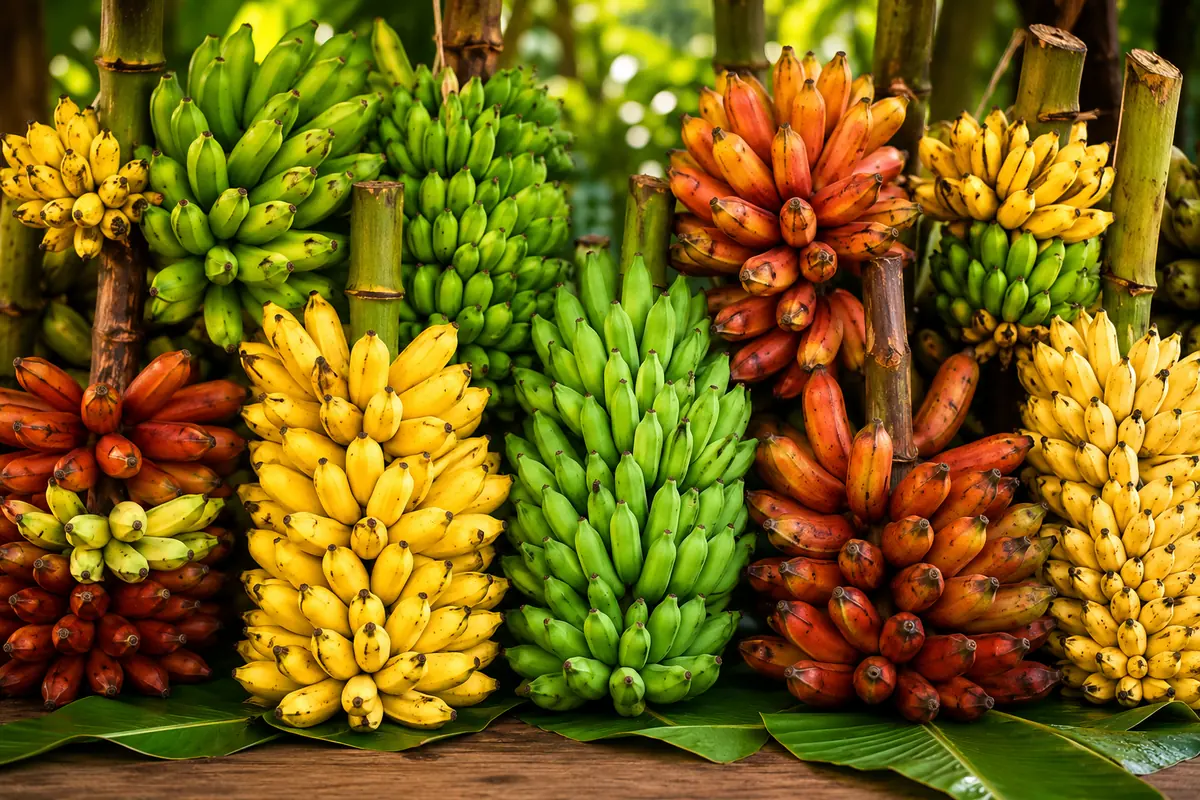
Nendran (നേന്ത്രൻ), also called Ethakka, is the banana most Kerala growers plant, and the one buyers ask us for most. It is the banana behind Kerala's chips, cooked dishes and the Onam trade, so its market is large and well established. For a commercial grower, Nendran vazhavithu is usually the first option to consider.
- Spacing: KAU recommends 2.0 m × 2.0 m spacing, about 2,500 plants per hectare. That works out to roughly 1,012 suckers per acre, or about 10.1 per cent.
- Preparing the suckers: Cut the pseudostem back to 15–20 cm above the corm and remove old roots and damaged parts. Smear the corm with cow-dung slurry and ash, dry it in the sun for about 3–4 days, and keep it in shade for up to 15 days before planting. In heavy rain, don't cut the suckers — waterlogged cut ends can rot.
- Timing: KAU recommends planting in May–June or September–October. A KAU field study found that planting Nendran after October lengthened the crop duration, so don't leave it too late.
Nendran prices also move a lot. Farmgate prices crossed ₹70/kg ahead of Onam 2026, a 12-year high (Onmanorama), after a season in which many growers had left the crop. If you plan to plant Nendran for the next season, book your suckers early, because demand peaks just before each planting window.
More on sucker size and handling: Nendran vazhavithu.
Robusta: a heavy-bunching table banana
Robusta (റോബസ്റ്റ) is a Cavendish-type dessert banana grown for the table-fruit market. Under good management, KAU lists Robusta yields of 38–45 tonnes per hectare, which makes it a strong choice for growers selling ripe fruit in volume.
- Spacing: KAU recommends 2.4 m × 1.8 m spacing, about 2,310 plants per hectare. That works out to roughly 935 suckers per acre, or about 9.3 per cent.
- Preparing the suckers: Trim off old roots, large side buds and damaged parts. Unlike Nendran, Robusta suckers don't need to be dried before planting.
- Coconut gardens: KAU lists Robusta among the varieties suitable for intercropping in coconut gardens.
Choose Robusta if you have a buyer for ripe dessert bananas and can give the crop regular water and manure. More details: Robusta banana suckers.
Njali Poovan: small, sweet and garden-friendly
Njali Poovan (ഞാലിപ്പൂവൻ) is the small, sweet banana that many Kerala households grow at home. KAU notes it is particularly suitable for intercropping in coconut gardens, so it is a natural fit for the many Kerala farms where bananas share space with palms. It also sells as a premium table fruit.
- Spacing: KAU doesn't publish a separate figure for Njali Poovan. In a coconut garden, plant in the open spaces between palms. Tell us your layout and we'll suggest a number.
- Preparing the suckers: Trim off old roots, large side buds and damaged parts. Unlike Nendran, Njali Poovan suckers don't need to be dried before planting.
If you search for njalipoovan vazhakannu because you want a few plants for the house, or a few hundred for a coconut garden, this is the variety to look at. More details: Njali Poovan vazhavithu.
Palayankodan: the hardy, low-maintenance choice
Palayankodan (പാളയംകോടൻ), sold in many markets as Poovan or Mysore Poovan, is a hardy table banana that does well with little care. It is a good choice for land without reliable irrigation, or for growers who can't visit the plot often.
- Spacing: KAU recommends 2.1 m × 2.1 m spacing, about 2,260 plants per hectare. That works out to roughly 915 suckers per acre, or about 9.1 per cent.
- Preparing the suckers: Trim off old roots, large side buds and damaged parts. Unlike Nendran, Palayankodan suckers don't need to be dried before planting. For a rainfed crop planted in January, KAU suggests giving each plant about 9 litres of water once every 15 days until April–May.
More details: Palayankodan vazhavithu.
Not sure which variety suits your land?
Send us the variety, quantity (or land area), your district and the month you plan to plant. We'll confirm availability and today's rate.
How to choose the right vazhavithu for your plot
Answer these four questions in order. Most growers have their answer by the second one.
1. Where will you sell the bunches?
This matters more than anything else. If your buyers are chips makers, hotels, or traders supplying the Onam market, plant Nendran. If you sell ripe fruit to shops and wholesale markets, Robusta or Palayankodan fit better. If the crop is mainly for your household, with some for sale, Njali Poovan is the usual choice.
2. Is the land open or under coconut palms?
In an open field you can plant at full KAU spacing, and Nendran or Robusta make the most of the space. Under coconut palms, KAU points to Njali Poovan and Robusta.
3. Can you water the crop through the dry months?
Nendran and Robusta repay regular irrigation and manuring. If your plot depends on rain, Palayankodan is the safer pick. KAU suggests planting it in January and pot-watering until the monsoon arrives.
4. When do you want to harvest?
KAU says bunches emerge about 7–8 months after planting, and recommends timing planting so this doesn't fall in hot, dry weather. Work backwards from your harvest month to your planting date, then order suckers for that date. Our bulk order guide has a table of how many suckers each variety needs for plots from 10 cents to 5 acres.
Whatever you choose, start with a good sucker
The best variety for your market won't perform if the planting material is weak or diseased. KAU's advice applies to every variety: plant disease-free sword suckers from healthy clumps.
- Sword suckers, not water suckers. Look for narrow, sword-shaped leaves and a broad, well-developed base.
- The right age and size: 3–4 months old, weighing about 700–1,000 g at the base, with a girth of 35–45 cm around the base.
- A clean, firm corm with no rot, tunnels or dark patches.
- Even size across the batch, so the plants grow and bunch at roughly the same time.
Once the suckers arrive, our step-by-step planting guide covers pit size (50 cm × 50 cm × 50 cm), liming, manuring and treatment. Weighing up suckers against lab-grown plants? Read banana suckers vs tissue culture.
Where to buy vazhavithu in Kerala
BT Banana supplies Nendran, Robusta, Njali Poovan and Palayankodan suckers, sourced from established banana nurseries in the Trichy belt of Tamil Nadu. We deliver them from our base in Alakode, Kannur, to farms and nurseries in all 14 districts of Kerala. We supply suckers only, not tissue culture plants. See Vazhavithu for sale for varieties and delivery details, or send us your land area, district and planting month for a quote.
Get help choosing and a quote
Send us the variety, quantity (or land area), your district and the month you plan to plant. We'll confirm availability and today's rate.
Frequently asked questions
Which banana variety is best for Kerala?
There is no single best variety; it depends on where you will sell. Nendran is the most widely grown in Kerala because it serves the cooking, chips and Onam markets. Robusta suits commercial table-banana plantations, Njali Poovan suits home gardens and coconut-garden intercropping, and Palayankodan suits rainfed, low-maintenance plots.
Which vazhavithu is best for a coconut garden?
Kerala Agricultural University (KAU) lists Njali Poovan as particularly suitable for intercropping in coconut gardens, and Robusta as suitable too. Count the open spaces between palms, not the total land area, when working out how many suckers you need.
Which banana variety needs the least care?
Palayankodan (Mysore Poovan) is the hardiest of the four and does well with little care. For a rainfed crop, KAU suggests planting it in January and pot-watering each plant until the rains arrive.
Do all banana suckers need to be dried before planting?
No. KAU advises sun-drying only Nendran suckers, for about 3–4 days after treating the corm. Robusta, Njali Poovan and Palayankodan suckers are trimmed and planted without the drying step.
Are vazhavithu and banana seeds the same thing?
In everyday Kerala usage, yes. People search for 'banana seeds', but edible bananas are grown from suckers (vazhavithu or vazhakannu), the young shoots that grow from the base of a parent plant, not from true seeds.
Can I plant more than one variety in the same plot?
Yes, but plant each variety in its own block. Each variety has its own spacing, treatment and crop duration, and keeping them apart makes watering, manuring and harvesting much simpler.
Agronomy figures follow Kerala Agricultural University (KAU) recommendations. Local conditions vary — for field-specific advice, check with your Krishi Bhavan.