Quick answer
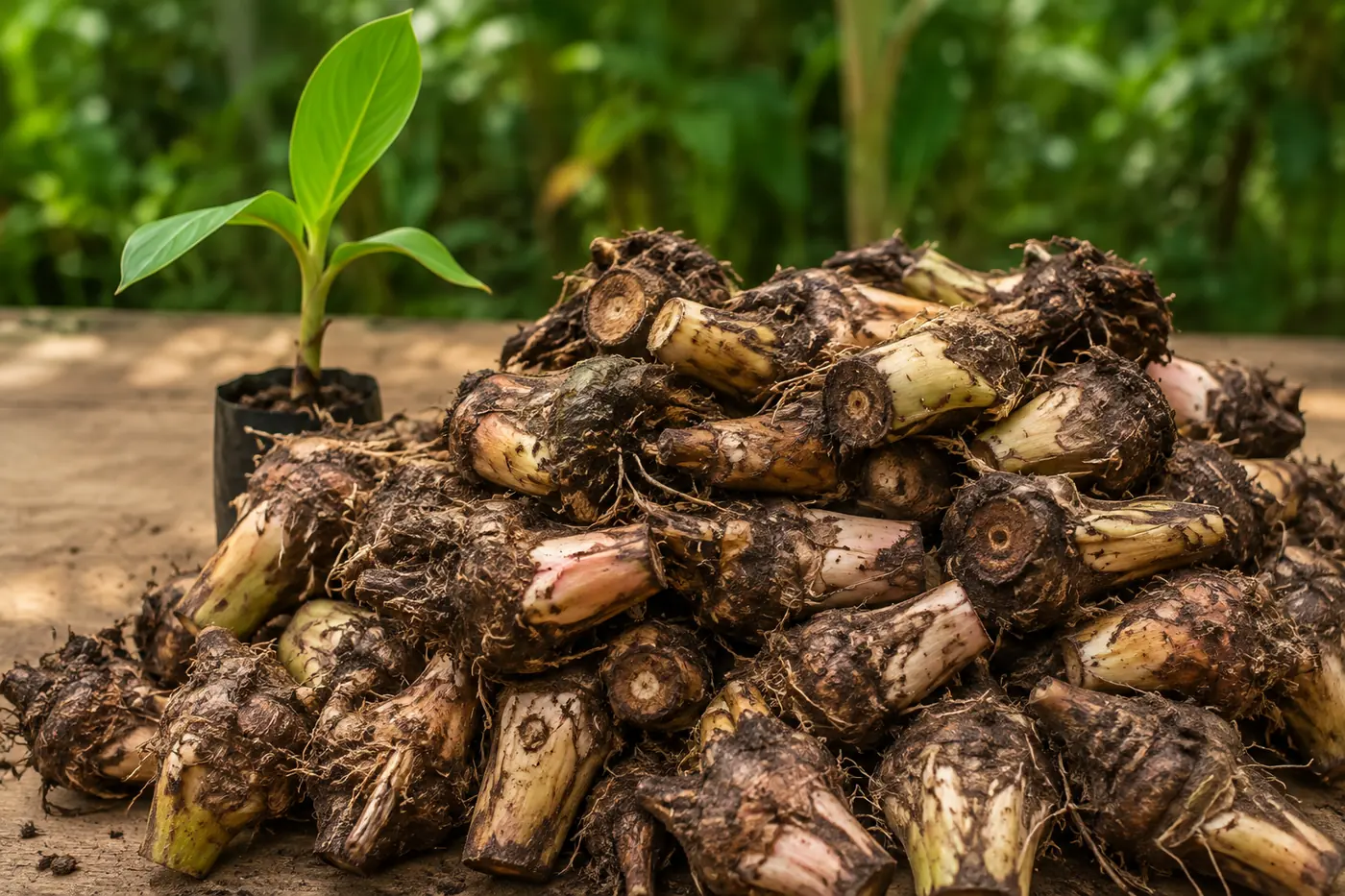
Most people searching for vazhavithu or vazhakannu (വാഴവിത്ത് / വാഴക്കന്ന്) need more than a handful of plants. They are planning a plot, a plantation or a nursery batch. Buying hundreds or thousands of suckers at once raises questions a home gardener never has to think about. How many exactly? When should they arrive? And how do you know the consignment is healthy before it goes into the ground?
This guide answers those questions using Kerala Agricultural University (KAU) recommendations, plus what we've learned supplying suckers to growers across the state.
1. Work out how many suckers you need
The number of suckers depends on two things: your land area and the spacing recommended for the variety. Kerala land is usually measured in cents (100 cents = 1 acre), so here are KAU's spacings converted into plant counts for common plot sizes:
| Land area | Nendran2.0 m × 2.0 m | Robusta2.4 m × 1.8 m | Palayankodan2.1 m × 2.1 m |
|---|---|---|---|
| 10 cents | ~101 | ~93 | ~91 |
| 25 cents | ~253 | ~234 | ~229 |
| 50 cents | ~506 | ~467 | ~457 |
| 1 acre | ~1,012 | ~935 | ~915 |
| 2 acres | ~2,023 | ~1,870 | ~1,829 |
| 5 acres | ~5,059 | ~4,674 | ~4,573 |
Spacing and plants-per-hectare figures from KAU, converted at 1 hectare = 247.1 cents. KAU doesn't publish a separate spacing for Njali Poovan, so ask us for advice on your plot.
Add a small margin for gap filling
A few suckers in any planting may fail to establish. Many growers order a small extra margin (for example around 5%) so they can fill gaps within the first few weeks, while the replacement still keeps pace with the rest of the crop. For a one-acre Nendran plot, that means ordering roughly 1,063 instead of 1,012.
2. Book around Kerala's planting windows
KAU recommends planting banana suckers in May–June or September–October, and advises growers to avoid periods of heavy monsoon and severe summer. Those two windows are when demand for suckers, especially Nendran, peaks, so the earlier you confirm a bulk order, the easier it is to get the variety and quantity you want on the date you want.
- Work backwards from your harvest. According to KAU, bunches emerge about 7–8 months after planting, and planting should be timed so this doesn't fall in hot, dry weather. If you're aiming for a festival market like Onam, plan your planting date first and order suckers to match it.
- Don't plant Nendran too late. A KAU field study at Ambalavayal found that July–October plantings gave similar bunch weights, while planting Nendran after October lengthened the crop duration.
- Have the pits ready before the suckers arrive. KAU recommends pits of 50 cm × 50 cm × 50 cm. Digging and liming pits ahead of delivery means a large consignment can go into the ground within days, not weeks.
3. Match the variety to your market
In a bulk order, the variety decides who will buy your harvest. A quick guide to the varieties we supply:
| Variety | Best for |
|---|---|
| Nendranനേന്ത്രൻ | Commercial plantations, chips and cooking markets, Onam crop, home gardens |
| Robustaറോബസ്റ്റ | Commercial table-banana plantations, intercropping in coconut gardens |
| Njali Poovanഞാലിപ്പൂവൻ | Home gardens, coconut-garden intercropping, premium table-fruit markets |
| Palayankodanപാളയംകോടൻ | Rainfed and low-maintenance plots, home gardens, intercropping |
Nendran is the variety most Kerala growers ask us for. It serves the chips, cooking and festival markets. If you're unsure, tell us where you plan to sell and whether your plot is irrigated, and we'll suggest a variety. Our guide to choosing the right vazhavithu compares the four varieties in detail.
Planning a bulk Vazhavithu order?
Send us the variety, quantity (or land area), your district and the month you plan to plant. We'll confirm availability and today's rate.
4. What a healthy bulk consignment looks like
With thousands of suckers, a small share of poor planting material can cost you a lot of bunches. KAU's advice is to plant disease-free sword suckers from healthy clumps. When the consignment arrives, check a sample from different bundles against this list:
- Sword suckers, not water suckers. Sword suckers have narrow, sword-shaped leaves and a well-developed base. Broad-leaved water suckers don't grow into strong plants.
- The right age and size. KAU recommends suckers 3–4 months old, weighing about 700–1,000 g at the base with a girth of 35–45 cm around the base.
- A clean corm. The base should be firm, with no rotting, tunnels or dark patches. When you pare the corm before planting, cut away any discoloured tissue.
- Uniform size across the batch. Even-sized suckers grow and bunch at roughly the same time. That makes field work and harvesting easier.
Why disease-free matters: bunchy top
KAU notes that symptoms of bunchy top, a virus spread by banana aphids, appear when infected suckers are planted. Affected plants stay stunted and don't produce a bunch of commercial value. The first line of defence is planting suckers from healthy clumps, and removing any plant that shows symptoms.
On delivery day
- Unload into shade and count the suckers against your order.
- Photograph anything damaged and report it to your supplier the same day, while the problem is easy to verify.
- Prepare the suckers for planting. For Nendran, KAU advises cutting the pseudostem back to 15–20 cm, removing old roots, smearing the corm with cow-dung slurry and ash, and drying it in the sun for about 3–4 days. Other varieties don't need the drying step. The full method is in our planting guide.
- Plant within about two weeks. KAU notes treated suckers can be kept in shade for up to 15 days.
5. What decides the price of bulk vazhavithu
There's no single "vazhavithu vila". Sucker prices move with the season, and a bulk quote depends on:
- Variety. Nendran is in the highest demand.
- Quantity. Larger orders are usually quoted at a better rate per sucker.
- Sucker size and grade. Larger, uniform sword suckers cost more than mixed or undersized stock.
- Timing. Demand peaks just before each planting window.
- Delivery distance within Kerala.
As a public reference point, Kerala Agricultural University's 2025-26 planting-material price list lists Nendran-group suckers at ₹20 each from its own farms. For a bulk order, it's always best to ask for a quote on the day, because rates change through the season.
Comparing quotes? Compare like for like: the same variety, sucker size, quantity and delivery to your farm. A cheaper quote for smaller or mixed suckers often costs more later in gap filling and uneven growth.
6. How to order bulk vazhavithu from BT Banana
We source our Vazhavithu from established banana nurseries in the Tiruchirappalli (Trichy) belt of Tamil Nadu. We bring it into Kerala through our base in Alakode, Kannur, and deliver to farms and nurseries in all 14 districts of Kerala. We supply suckers only. We don't sell tissue culture plants.
- Send us four details on WhatsApp or by phone: variety, quantity (or land area in cents/acres), your district or town, and the month you plan to plant.
- We confirm availability and today's rate, including delivery to your location.
- We agree a delivery date that fits your planting window, so your pits can be ready in time.
- Your suckers arrive, ready for you to check, treat and plant.
Ready to plan your order?
Send us the variety, quantity (or land area), your district and the month you plan to plant. We'll confirm availability and today's rate.
Frequently asked questions
How many Nendran suckers do I need for one acre?
At KAU's recommended Nendran spacing of 2 m × 2 m you need about 1,000 suckers per acre (about 2,500 per hectare). Many growers order a small extra margin — for example 5% — to replace any suckers that fail to establish.
How many banana plants fit in 10 cents of land?
About 100 Nendran plants at 2 m × 2 m spacing (roughly 10 plants per cent). Robusta at 2.4 m × 1.8 m works out to about 93 plants, and Palayankodan at 2.1 m × 2.1 m to about 91.
When is the best time to plant banana suckers in Kerala?
Kerala Agricultural University gives two main windows: May–June and September–October. Avoid planting during heavy monsoon or severe summer, and time planting so bunches (which emerge about 7–8 months later) don't appear during hot, dry weather.
How long can banana suckers be kept before planting?
KAU notes that treated suckers can be stored in shade for up to 15 days before planting. Keep them out of the sun and rain, and plant them as soon as your pits are ready.
Do you sell tissue culture banana plants?
No. BT Banana supplies banana suckers (vazhavithu) only — sword suckers sourced from banana nurseries in Tamil Nadu and delivered across Kerala. We don't sell tissue culture plants.
Do you deliver bulk vazhavithu to my district?
We deliver Vazhavithu to farms and nurseries in all 14 districts of Kerala, from Kasaragod to Thiruvananthapuram. Send your district and quantity on WhatsApp and we'll confirm delivery and today's rate.
Agronomy figures follow Kerala Agricultural University (KAU) recommendations. Local conditions vary — for field-specific advice, check with your Krishi Bhavan.